
Sagar Club K3
K3 rolls three dice every period. You follow the total, its size, or whether the dice form a pair or a triple.
3 dice Totals 3–18 Pairs · Triples
Sagar Club 2026 · Adults 18+ only · Updated October 2026
Quick answer
K3 rolls three six-sided dice per period. Totals range from 3 to 18; 11–18 is Big and 3–10 is Small. Other choices include a specific total, odd/even, pairs and triples.
On this page
— SCREEN
The K3 screen, marked up
Four areas.
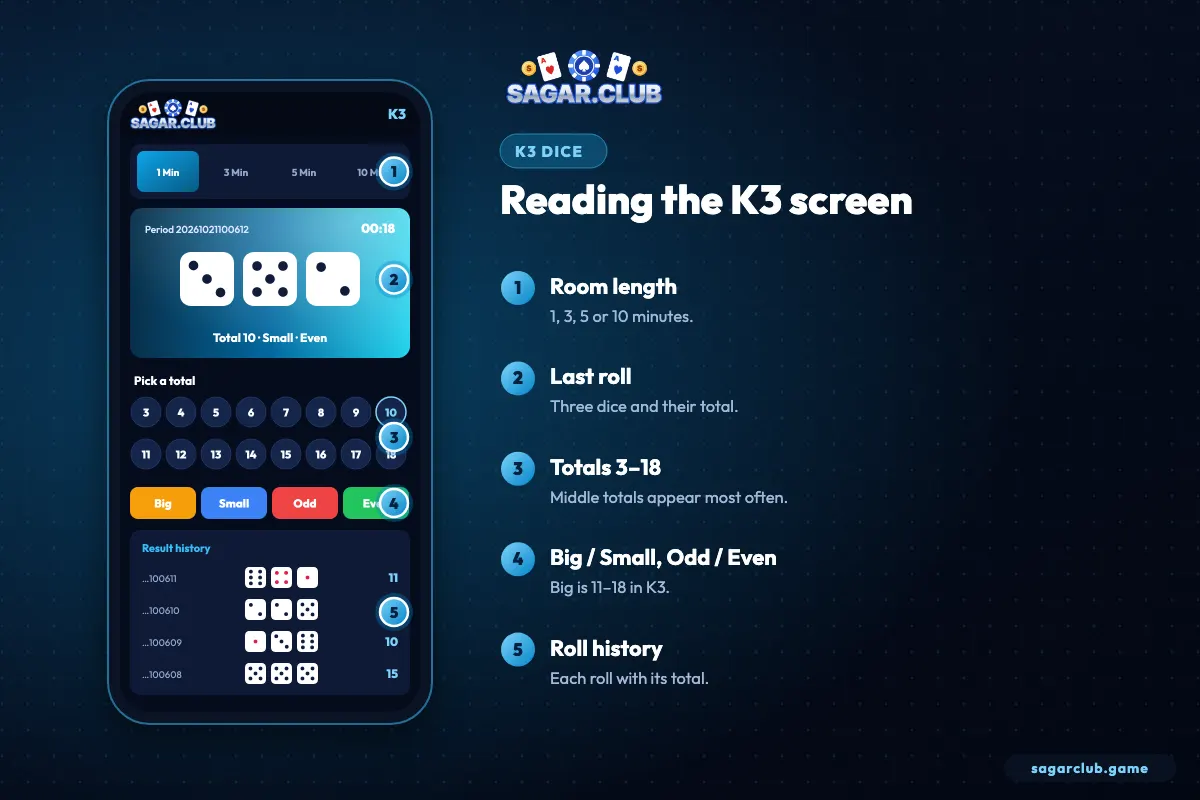
- Room timer and period ID.
- Last result – three dice and their total.
- Total, Big/Small and Odd/Even choices.
- Pair, triple and history tabs.
— TOTALS
How often each total appears
Middle totals are common; extremes are rare.
| Total | Combinations |
|---|---|
| 3 or 18 | 1 of 216 |
| 4 or 17 | 3 of 216 |
| 5 or 16 | 6 of 216 |
| 6 or 15 | 10 of 216 |
| 7 or 14 | 15 of 216 |
| 8 or 13 | 21 of 216 |
| 9 or 12 | 25 of 216 |
| 10 or 11 | 27 of 216 |
Three dice can land in 216 equally likely ways. A total of 10 or 11 can be made in 27 of them; a total of 3 or 18 in only one. That’s simply arithmetic – it describes long-run frequency, not what comes next. Knowing it helps you read the screen without surprise when middle totals keep appearing.
— CHOICES
Choice types in K3
From broad to very narrow.
| Choice | Meaning | How broad |
|---|---|---|
| Big / Small | Total 11–18 or 3–10 | Broad |
| Odd / Even | Total odd or even | Broad |
| Specific total | One value from 3 to 18 | Narrow |
| Pair | Two dice match | Medium |
| Triple | All three match | Very narrow |
— TIPS
Reading K3 calmly
Habits that keep it simple.
- Start in the 3- or 5-minute room.
- Watch a few rounds before joining.
- Treat the trend view as history, not a forecast.
- Stop at the limit you set.
Every result is random and independent. No chart, group, app or ‘hack’ can predict the next one – anyone selling predictions is running a scam.
— EXAMPLE
Reading one K3 result
A worked example.
Imagine the dice show 2, 5 and 5. The total is 12, which is Big (11–18) and even. Two dice match, so the result is a pair of fives. It isn’t a triple, because the third die is different. That single roll can be described as ‘total 12’, ‘Big’, ‘even’ or ‘pair’ – which is why the K3 screen offers several tabs for different kinds of choice. Practising this on the history list for a few minutes makes the screen feel simple.
If the dice showed 4, 4 and 4, the total would be 12 again, but now the result is also a triple – the rarest outcome in K3.
— TRIPLES
How rare pairs and triples are
Arithmetic, not a forecast.
Of the 216 ways three dice can land, only six are triples (1-1-1 through 6-6-6), so any triple appears roughly once in 36 rolls on average. Pairs are much more common – 90 of the 216 combinations contain exactly two matching dice. These numbers describe what happens over very many rolls. They don’t make a triple ‘due’ after a long gap, and they don’t make one unlikely straight after another.
— ROOMS
Choosing a K3 room
Slower is easier.
K3 rooms run from 1 to 10 minutes. The 1-minute room is fast enough that the dice animation, result and next countdown follow one another with little pause. The 5- and 10-minute rooms leave time to read the result, check the total against the table on this page and decide calmly. While learning, choose a slow room and watch several rounds before joining.
— RECAP
K3 in one paragraph
The essentials.
K3 rolls three six-sided dice every period. Totals run from 3 to 18; 11–18 counts as Big and 3–10 as Small, and odd or even refers to the total. You can also follow a specific total, a pair or a triple. Middle totals such as 10 and 11 appear most often over the long run because they can be made in the most ways, while 3 and 18 are rare. Triples appear about once in thirty-six rolls on average. None of this predicts the next roll. Learn in a 5- or 10-minute room, watch first, and keep sessions short and planned.
For the bigger picture of rooms, rewards and safety, see our complete Sagar Club guide.
Open Sagar Club the right way
Use the official app or website – one Sagar Club account works on every device.
— FAQ
Frequently asked questions
What is Big in K3?
A total of 11–18.
Which totals are most common?
10 and 11.
Can I see past dice?
Yes – the history tab under the game.
Is a total of 10 Big or Small?
Small. Big starts at 11.
Can K3 dice show the same number three times?
Yes – that’s a triple, the rarest outcome.