
Sagar Club Big, Small, Odd & Even
The broad choices appear in every lottery game, but the ranges differ. Here they are in one place.
Sagar Club 2026 · Adults 18+ only · Updated October 2026
Quick answer
WinGo: Big 5–9, Small 0–4. K3: Big 11–18, Small 3–10. 5D position: Big 5–9; 5D sum: Big 23–45. Odd and Even work on the number or total.
On this page
— RANGES
Ranges by game
One table for all four.
| Game | Big | Small | Odd / Even |
|---|---|---|---|
| WinGo / TRX | 5–9 | 0–4 | Odd / even number |
| K3 | 11–18 | 3–10 | Odd / even total |
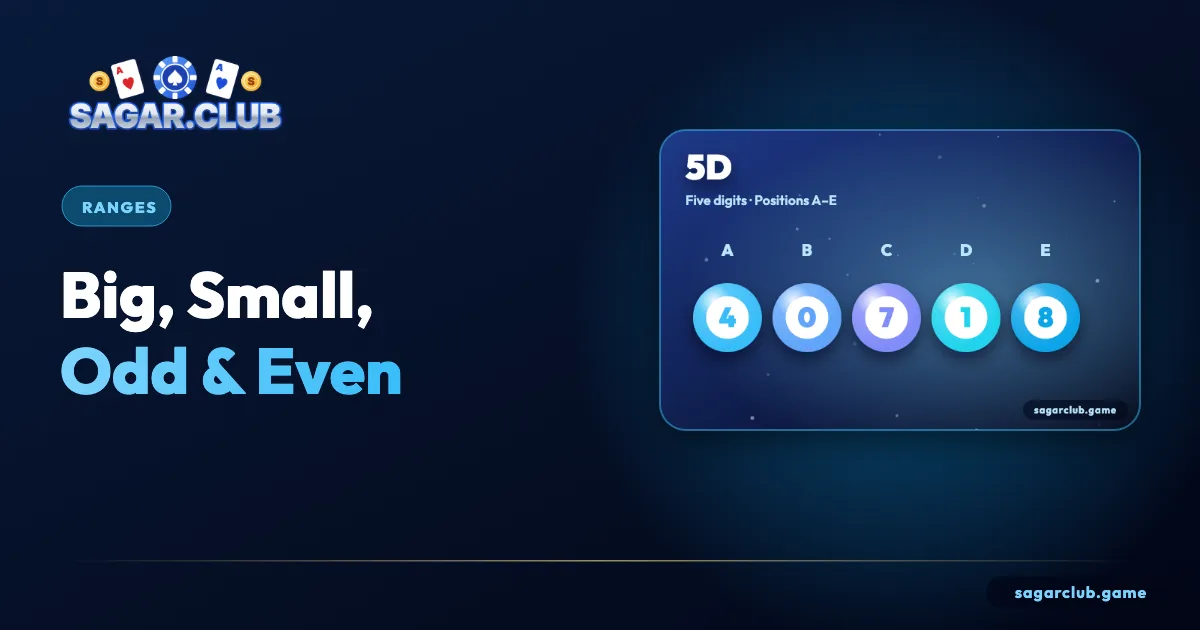
| 5D position | 5–9 | 0–4 | Odd / even digit |
| 5D sum | 23–45 | 0–22 | Odd / even sum |
— WHY
Why broad choices feel steadier
They cover more outcomes.
A broad choice covers roughly half of the possible results, so it comes up about half the time over many rounds. A single number covers one in ten. That’s why broad choices look ‘steadier’ on a chart – but no choice is ever certain, and runs of one side are completely normal.
Every result is random and independent. No chart, group, app or ‘hack’ can predict the next one – anyone selling predictions is running a scam.
— ODD/EVEN
Odd and even, explained
The other broad choice.
Odd and even look at whether the result (or total) divides by two. In WinGo, odd numbers are also the green ones and even numbers are the red ones – so odd/even and green/red line up, except for the violet exceptions at 0 and 5. In K3 and 5D, odd and even apply to the total or the chosen digit.
Like Big and Small, odd and even split results roughly in half over many rounds. Runs of one side are normal and don’t predict the next round.
— MISTAKES
Common mix-ups
And how to avoid them.
Using WinGo ranges in K3
Big in K3 starts at 11, not 5.
Forgetting 5 is Big
In WinGo and 5D positions, 5 counts as Big.
Confusing 5D position and sum
Check which tab is highlighted.
— HALVES
Why the ranges are split where they are
Two equal halves.
In WinGo and 5D positions, the ten digits 0–9 split neatly into two groups of five: 0–4 Small and 5–9 Big. In K3, totals run from 3 to 18; the split at 10/11 divides them into two halves that occur equally often over the long run, because the dice distribution is symmetrical around 10.5. The 5D sum, ranging from 0 to 45, splits at 22/23 for the same reason – symmetry around 22.5.
Knowing the logic makes the ranges easy to remember: in every game, Big and Small are designed to be two equal halves.
— RUNS
Long runs of Big or Small
Normal, not meaningful.
Because Big and Small each cover half the outcomes, many people expect them to alternate. In reality, random sequences produce runs – five, six, sometimes more of the same side in a row. These look striking on the trend chart, but they’re exactly what randomness produces. The next round is still a fresh half-and-half. Treat runs as a curiosity, never as a signal.
— CHOICE
Broad choices and session length
A practical observation.
Because Big/Small and Odd/Even resolve clearly every round, they can make sessions feel quick and easy. That’s exactly why time limits matter even more with broad choices – rounds flow into one another without natural pauses. Set an alarm before you start, and stop when it rings.
— RECAP
Big, Small, Odd and Even – recap
All ranges in one place.
In WinGo and TRX WinGo, Big is 5–9 and Small is 0–4. In K3, Big is a total of 11–18 and Small is 3–10. In 5D, a single position uses 5–9 for Big and 0–4 for Small, while the sum uses 23–45 for Big and 0–22 for Small. Odd and Even always refer to the number, total, digit or sum being followed. In every game, the two halves are designed to occur equally often over the long run, and runs of one side are a normal feature of randomness rather than a signal. Set a time limit, because broad choices make rounds flow quickly.
These ranges are the same in every room on Sagar Club, whichever timer you choose.
Open Sagar Club the right way
Use the official app or website – one Sagar Club account works on every device.
— FAQ
Frequently asked questions
What is Big in WinGo?
5–9.
What is Big in K3?
11–18.
Is 0 Small in WinGo?
Yes. 0 to 4 are Small, and 5 to 9 are Big.
Does Big come up more after a run of Small?
No. Each round is independent; runs don’t change the next result.